

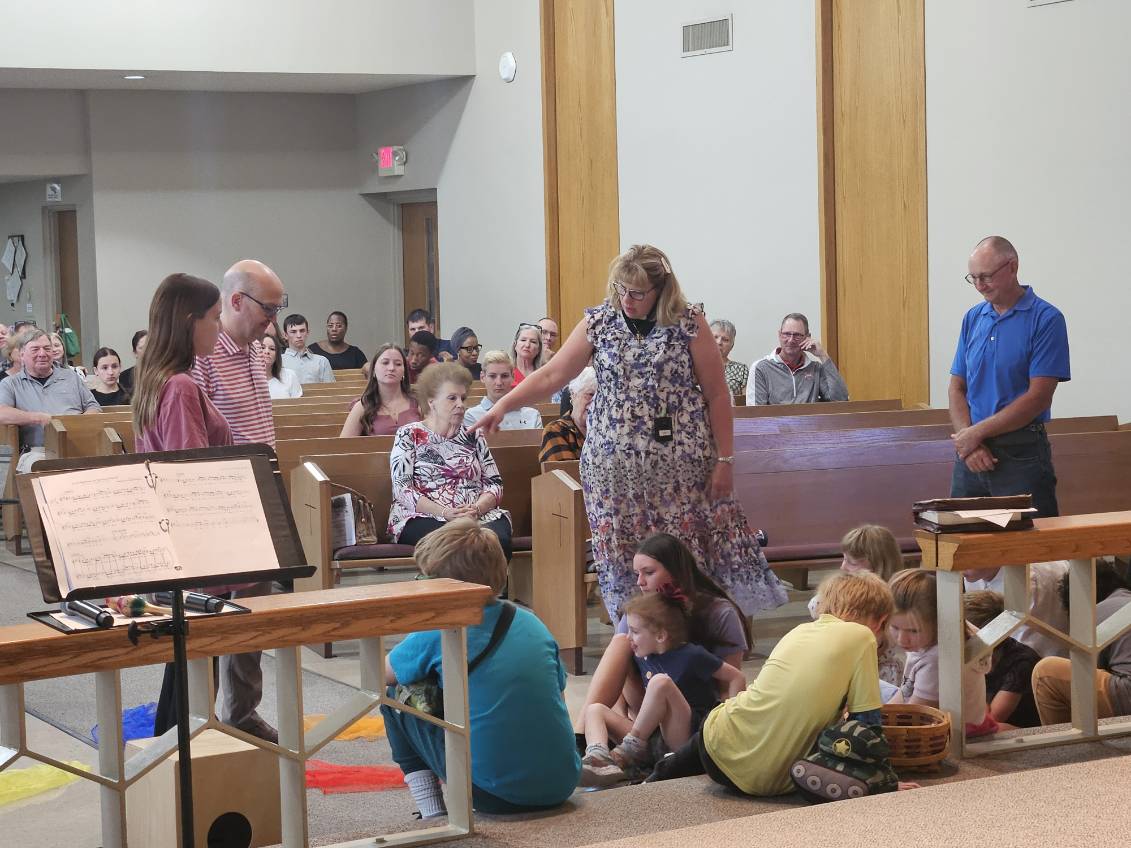
It was a joy to be with American Lutheran Church in Lincoln, Nebraska on October 5, 2025. Thank you to Pastor Carla Johnson for the invitation and to the whole congregation for the warm welcome. In being with the congregation I was invited to preach on stewardship as part of the congregation’s stewardship emphasis, bring greetings from Bishop Scott Johnson and share words of gratitude about the congregation’s ministry, as well as to lead a conversation during the Sunday School hour and share some news and opportunities about what is happening across the Nebraska Synod. What follows is the majority of the manuscript I preached from for the 17th Sunday after Pentecost (Lectionary 27C), which was based especially on Luke 17:5-10; 2 Timothy 1:1-14; and Psalm 24. If you would rather like to listen or watch the sermon and worship services, you can do that via the congregation’s YouTube livestreams which can be found below.
Grace and peace from God in Christ, who is with you, for you, and who loves you. Amen.
An Old Familiar Gospel Story about Faith and a Mustard Seed
“Increase our faith!”[1] “Increase our faith!” Could you imagine being so bold, that you would demand this, especially in such a clear way from Jesus? I imagine it’s kind of like when my two young daughters who I adore, come to me and demand that I do something. “Daddy, do this!” “Daddy, I want …” you fill in the blank. Perhaps you know what I mean. That nagging, demanding at times, sense of entitlement. We’ve probably all said things like this in our lives, if we are being honest. But it doesn’t change the fact, that at least in the way Luke tells this story, the disciples or apostles are not being painted in a good light here. But that’s more the norm than not, isn’t it? “Increase our faith!” I wonder if this might be an example of when the disciples demand or say something, and they really don’t know what they are saying? Like when the two were arguing along the road earlier on their journey together about who the greatest was and who could be at Jesus’ side.
But to their request, Jesus takes a moment and teaches. He doesn’t quite go into full parable telling mode, like he often does. But sort of. Jesus replies with an old familiar gospel story that we all know well. “If you had faith the size of a mustard seed, you could say to this mulberry tree, ‘Be uprooted and planted in the sea,’ and it would obey you.”[2] A mustard seed is not large. On average they are 1-2 millimeters. They are about as small as a seed can be while still being visible to the naked eye. That doesn’t seem to imply the need for a large or big faith. But Jesus is making a point. Faith is a gift. It’s a gift of God and the Spirit. It doesn’t have to be huge. But like any seed that is planted, it does have to be nurtured to grow. And when it is, amazing things happen. Because God is at work. And because God is the one who activates the gift of faith. Because God is the one who is active, among God’s people, and up to something. Yes, a mulberry tree could be uprooted and planted in the sea. The thing about faith, just like seeds, is that they need to be intentionally developed. Cared for. Cultivated. Stewarded. Practiced. If not, they may not grow.
We’ll come back to that. But Jesus is also making a point about discipleship in general. Being a disciple and steward of God’s love, means being a follower. It means being a follower of Jesus. A co-participant in God’s kin-dom building work here and now. It’s not about glorification. It’s not about prosperity or power. It’s about service, empathy, compassion, mercy, and love. That’s perhaps why it’s so hard to hear what Jesus says next about being a slave. But in alluding to the culture of the time, where not everyone had equal worth and value in the economy or society of that day, Jesus says, “So you also, when you have done all that you were ordered to do, say, ‘We are worthless slaves; we have done only what we ought to have done!’”[3] Being a disciple, means admitting that we are not in control. It means admitting that everything in this world and life, is not all up to us. We confess that we are not God.
Through baptism and the affirmation of our faith, we commit that we are obedient to our Triune God, without whom we would not have the same knowledge and experience of the love and life-giving grace that God provides. In thinking about faith, there is an element of it that calls us to obedience. To follow in hope when things may not seem as they ought. To meet our neighbor’s needs, even when it may not be easy or ideal for us to do so. To follow our Lord and Savior when things feel like a mystery, unexplainable, or wrong in the world around us. To keep going with the persistence and trust that was shown and taught to us by those who came before us- our parents, grandparents, pastors, deacons, and like for Timothy in our second lesson, all of the Lois’ and Eunice’s of our lives who compassionately and lovingly showed us the way so that we might grow and help others grow.[4] This is part of what it looks like to be a disciple and steward. To follow our Lord as God in Christ leads and calls us. And to help others to go and do the same.
Faith with Intention
The thing about faith, at least in having the faith like an itsy bity hopeful mustard seed, is that there needs to be intention. Where we are intentional in what we do and why we do it. That goes for everything that we are as Children of God. To embody the truth that all of God’s beloved, are Children of God. With equal value and worth because they are each God’s own. Period. It’s amazing how hard it can be to live into this reality when the world around us each day and particularly from those in power, try to tell us differently.
If our faith is like a mustard seed, it’s one that calls us back to these waters and to the baptismal promises we all make. The promises that we will, “live among God’s faithful people, hear the word of God and share in the Lord’s supper, we’ll proclaim the good news of God in Christ, through word and deed, we will serve all people, following the example of Jesus, and we will strive for justice and peace in all the earth.”[5] These are promises we each make, and they are marks of discipleship. When we do them, it’s just like when one who plants a seed does what is necessary to help the seed grow as it ought. It’s like giving life-giving water, fertilizer, sunshine, and other nutrients. It’s like making space to prune when necessary to ensure the clearest path towards growth. To weed out that which is getting in the way. This is what it looks like to have faith with intention. To care for, cultivate, practice, and steward.
Stewardship with Intention
Now, speaking of stewardship, as I know we are in the midst of your congregation’s stewardship emphasis. Let’s take a step back and think about stewardship. Stewardship is our response. It’s our response to God’s love and gifts for us. It’s our response to our neighbor in need. God does, what God alone can do, for you and for me. We cannot earn God’s gifts of life and love. The gift like the writer of 2nd Timothy reminds, of abolishing death and bringing “life and immortality to light through the gospel.”[6] God does that work through the events of the cross, of Holy Week and Easter. God does that work over and over again through the water and word of baptism. But we are invited to joyfully and gratefully respond for what God has done, will do and promises to do, and this is a gift and opportunity.
Think of it as intentionally taking hold of the abundant life that God alone provides. We have the gift, call, and command to live out the life and identity we all share as a disciple and steward. But rest assured, this won’t always be easy. It will have its fill of challenges, and it’s costly. There’s a cross at its center after all. We know where the gospel story is leading. But we also know, because of this, that this life as disciples and stewards is deeply meaningful and full of purpose. It’s a life of service grounded in love and lived out in response to the promises of our God who comes near and is with us and loves us, always.

This is what stewardship looks like. Where we recall the words of the psalmist at the beginning of Psalm 24, “The earth is the Lord’s and all that is in it, the world, and those who live in it.”[7] The earth is God’s. And all who are part of the earth, are God’s too. Everything is God’s. You are God’s own. I am God’s own. And all that we have, and all that we are, is God’s also. Everything that makes you the unique person and beloved Child of God that you are, is God’s. Your time, talent, treasure, assets, possessions, and finances of all kinds. Your life, health, body, heart, soul, and mind. Your passions, strengths, vocations, gifts, relationships, ideas, dreams, stories, imaginations, and even your questions. All that is yours, is really God’s. And all of creation and the earth itself that surrounds us, and which God entrusts into our care in the beginning of Genesis, is God’s too. All of this and more, is God’s. And God chooses to entrust some of it into our care.
God does this because God loves you and God wants life to go well for you. God does this, because God does new things, and invites us each to be part of it. God does this too because God wants life to be meaning and purpose filled, perhaps through making a positive impact and difference like Jane Goodall used to say and do. So God invites you to follow and to use what God entrusts to meet your neighbor’s needs in some ways in daily life- here, now, today. Knowing that when we do this, we don’t do it alone. We do it with our God with whom there is always enough, and really more than enough. With our God who can take a few fish and a couple loaves of bread, and feed thousands. With our God who can share a simple commandment to “love one another,” and in so doing, change the world forever. With our God who shows that abundance is real, and scarcity is not- that abundance is the way of following Jesus with the faith the size of a mustard seed, and scarcity is the product of lies and sins the world and powers that be, might have us perpetuate and believe.
Making this Real- Your Joyful Response
So American Lutheran Church, what might this mean for you? As stewards of intention? As disciples with a faith the size of a mustard seed? I know this about you. I have been with you before. I have journeyed with you through the Nebraska Synod’s Vitality Initiative. As you continue that work of asking big questions of faith. Questions like who are we? Who are our neighbors? What might God be up to, and inviting us to be a part of? As you journeyed with your partner congregations in the first vitality cohort you pondered these questions and experimented. You also began to wonder and imagine what your unique vocation as a congregation might be.
Through your experimentation and discernment, and through my own witness of walking with you, I know this about you. You are faithful, with a good and deep understanding of stewardship. You want to be intentional as stewards and disciples, but like so many of us, including those first apostles, you might struggle from time to time. Because of all of the time commitments and challenges of what daily life might bring and demand. Because of all of the vocations we each have, as parents, children, grandparents, employees, retired persons, etc., etc. All of this is good and right. But faith comes in, as a way of planting and harvesting it all together, and being woven and cultivated together.

Like so many communities of faith, you might have times where you are afraid to risk. But as the message is said over and over in the gospels, “Do not be afraid.” God is with you, for you, and loves you. And because of this, you have all that you need. You are not alone. Jesus is with you. And I know that whatever fears you might have, they don’t get in the way of walking with your neighbors. Through all of your music ensembles, youth group, Sunday School, Vacation Bible School, quilters, Bible Study, Aging Partners, Prison Ministry, and more, you show up and you steward seeds of the faith. Through worship you are grounded in that which holds us fast. Through fellowship between services and conversation you also steward seeds of faith by growing and deepening relationships with your siblings in Christ right here. You do all this, because it’s part of what being an intentional disciple and steward looks like. One who is called and feels called to keep growing, serving, responding to and sharing God’s love with the world.
Your joy and gratitude are palpable, and it’s one of the reasons why I love any chance I get to come and be with you. Your joy and gratitude are your response. Your response as stewards for all that God has done, will do, and promises to do, for you. They are also your response as you go about cultivating and growing faith, one mustard seed at a time.

We may not always know what the seeds of faith we plant will become, but God will do God’s thing. Today as a church, in particular, we give thanks, for our now former Presiding Bishop Elizabeth Eaton and our new Presiding Bishop Yehiel Curry who was installed yesterday. These two leaders (pictured there yes with my wife- Pastor Allison Siburg and myself), just like each of you are called to tend, lead, and plant seeds of faith. We don’t do this ministry alone. We do this together, with our God who walks with us each step of the way and who helps the seeds grow through love and grace. People of God, be encouraged. Keep going. Keep cultivating. Keep loving. Keep serving. For your work and ministry as disciples and stewards matters. And through you and with you, God’s love is shown and made real near and far. Even if we may not always see what the seeds that are planted today might grow into, we know that with God as the one who ultimately grows them, God’s love and God’s work will be done. May it be so. Amen.
Citations and References:
[1] Luke 17:5, NRSVue.
[2] Luke 17:6, NRSVue.
[3] Luke 17:10, NRSVue.
[4] Noting Lois and Eunice as examples of the faith, as named in 2 Timothy 1:5, NRSVue.
[5] As found in Evangelical Lutheran Worship, (Minneapolis, MN: Augsburg Fortress, 2006), 236.
[6] 2 Timothy 1:10, NRSVue.
[7] Psalm 24:1, NRSVue.
 Timothy Siburg