

I had the privilege of being with God’s people gathered as First Lutheran Church in Blair, Nebraska on February 22 and 23, 2025. Thank you Pastor Glen Thomas for the invitation and to the whole congregation for the warm welcome. In being with the congregation, I was invited to preach, bring words of greetings and gratitude, and officially install Pastor Glen Thomas as senior pastor of First Lutheran Church. It was a joyous weekend of worship. What follows is the majority of the manuscript that I preached from, based on the revised common lectionary readings for the Seventh Sunday after Epiphany (Year C- Lectionary 7), particularly Luke 6:27-38 and Genesis 45:3-11. The congregation has been traveling through the Epiphany season with a series based on Brian McLaren’s “Life After Doom,” and I was assigned to think about the idea of the “depth of human spirit.” Additionally, some of this sermon was adapted from a commentary I wrote for the Stewardship of Life Institute. If you would like to watch or listen to the worship service and/or sermon, you can do that using the YouTube video from the congregation below, or by finding the congregation on Facebook for its various Facebook Live broadcast videos of all of its different worship services.
Grace and peace from God in Christ, who is with you, for you, and who loves you. Amen.
Spiritual Gifts[1]
First Lutheran, again it is so good to be with you today. This season of Epiphany, you have journeyed together as a congregation with a series of thoughts on spiritual gifts that are important in this current time. Today, I wonder with you about the depth of human spirit.
In the story from Genesis we heard today about Joseph and his brothers. Before we picked up the story in the reading, we remembered that Joseph had a spiritual gift of dreaming, but one which made his brothers very jealous and so much so that they sold him into slavery. Joseph’s slavery would take him from his homeland to Egypt. That could have been the end of Joseph’s story, and it could have meant a life of grief and regret for his brothers. But as we heard again today, that’s not at all what happens. Where Jospeh could have repaid his brothers and extended family with cruelty, he not only provided for them in their time of need with a promise that they would be cared for, but together as a family they would come to live out the practice and promise of reconciliation. They talked together.[2] They found common ground, and relationships were restored.

What could have justifiably been the end of relationship permanently, was not. What could have been an end to the story, was not. It’s kind of similar to the cross, isn’t it? For what many would presume as a sign of death and murder would be an end to the story, God made another way. We know this, don’t we? We’re a people who proclaim this and live this faith out each day of our lives. But in thinking first about Joseph and this spiritual gift of the depth of human spirit, there really is a depth to this that matters for each of us. This series you have been exploring informed by Brian McLaren’s Life After Doom seems timely. As more of the traditions and old ways of doing things seem to fall away within the church, society, and dare I say our everyday way of doing things and assumptions about how things are supposed to work, we could all bury our heads in the sand or throw our hands in the hair out of disgust and giving up. Or, this could be an opportunity. Like Joseph, perhaps we are being invited on a different path. I wonder if God is actually inviting us during this time to discover more deeply that which holds us together- Christ’s love which is at the heart of our faith and life together. Christ’s love which Jesus explains clearly today in his “Sermon on the Plain” is all about mercy.
Jesus’ Sermon on the Plain Continues this Week
Jesus calls us to show mercy. There really should be nothing remarkable about this. But somehow, in this time and space that we are living in, perhaps these words ring differently? Not only are we called to love our “enemies,”[3] Jesus calls us to show mercy.[4] To love and care. To embody compassion and foster reconciliation. To live out the golden rule, to “Do to others as you would have them do to you.”[5] We know this. It’s part of our DNA as disciples, stewards, and Children of God.

These words from Jesus to the crowd and those first disciples gathered and pressing in all around Jesus on that level place so long ago, are words for us today too. They are words for us about who we are called to be and to live as followers of Jesus. They are words about how we are to be in relationship with one another. Just like Joseph showed in reconciling with his brothers. Jesus’ preaching grounds us in how we are to live, love, and serve. These words are both comforting and challenging. Perhaps even more so today than when Jesus first proclaimed them- meeting the people where they were at, as many were in fear of the empire while holding out hope of a better day, many feared that they were not welcomed, and others worried about where the day’s bread for their family might come from.
Jesus’ Message might not be the easiest to hear and live out
Jesus preaches, “love your enemies, do good, and lend, expecting nothing in return. Your reward will be great, and you will be children of the Most High, for he himself is kind to the ungrateful and the wicked. Be merciful, just as your Father is merciful.”[6] We know this message. But we also know that this preaching and wisdom are not the usual message one might hear lifted up in the world and society all around us. But Jesus came not to maintain the status quo, but so that all might know that God’s love and mercy is real and is for them, for you, and for all.

This message matters, but for whatever reason it’s not always the easiest to hear and live out. Just about a month ago, Episcopalian Bishop Mariann Budde was preaching in the National Cathedral in Washington D.C. at a service following President Trump’s inauguration. Bishop Budde offered a plea for those in need and for all those who might feel afraid, that they be shown mercy and compassion. The Bishop was simply doing as Jesus instructs in the gospel today, but her message of mercy has received condemnation by many political and religious authorities. This is an Epiphany for all of us. Jesus’ message of mercy is straight forward enough, but it is sorely needed now more than ever. It’s a message that brings good news and compassion to the poor and challenge to the rich, as Jesus proclaimed earlier in his sermon and we heard last week.[7] It’s a message that Jesus shows through word and deed, that through Christ all things are made new.
As the Body of Christ today, we are called to show and proclaim likewise. We are called to share and steward God’s love and mercy. We live this out through loving. We live this through not hating another, but through doing good. Through helping others in need without hope or expectation of interest earned. Through doing what is right, no questions asked.
The Depth of Human Spirit: our response and work as Stewards and Disciples
When we live this out and lean into and live out Jesus’ words in word and deed, and when we follow the example of our ancestor Joseph, the depth of human spirit becomes truly apparent. It becomes obvious through our response and work as stewards of God’s of love, and disciples and followers of Jesus. For example, Jesus preaches, “Do not judge, and you will not be judged; do not condemn, and you will not be condemned. Forgive, and you will be forgiven; give, and it will be given to you. A good measure, pressed down, shaken together, running over, will be put into your lap, for the measure you give will be the measure you get back.”[8]
We are called to forgive and to give. We are called to live out the promise of abundance of God’s love. Where Jesus says, a good measure will be running over, and “the measure you give will be the measure you get back,” some might interpret this as a sort of act of investing. It might be that, if that metaphor helps you imagine what this looks like. But more holistically, this is really about doing all that we are supposed to be doing. Showing love. Caring for our neighbors. Using what God entrusts into our care, wisely and for the sake of others. Doing so joyfully, gratefully, and mercifully in response for all that God in Christ has done, will do, and promises to do for us.
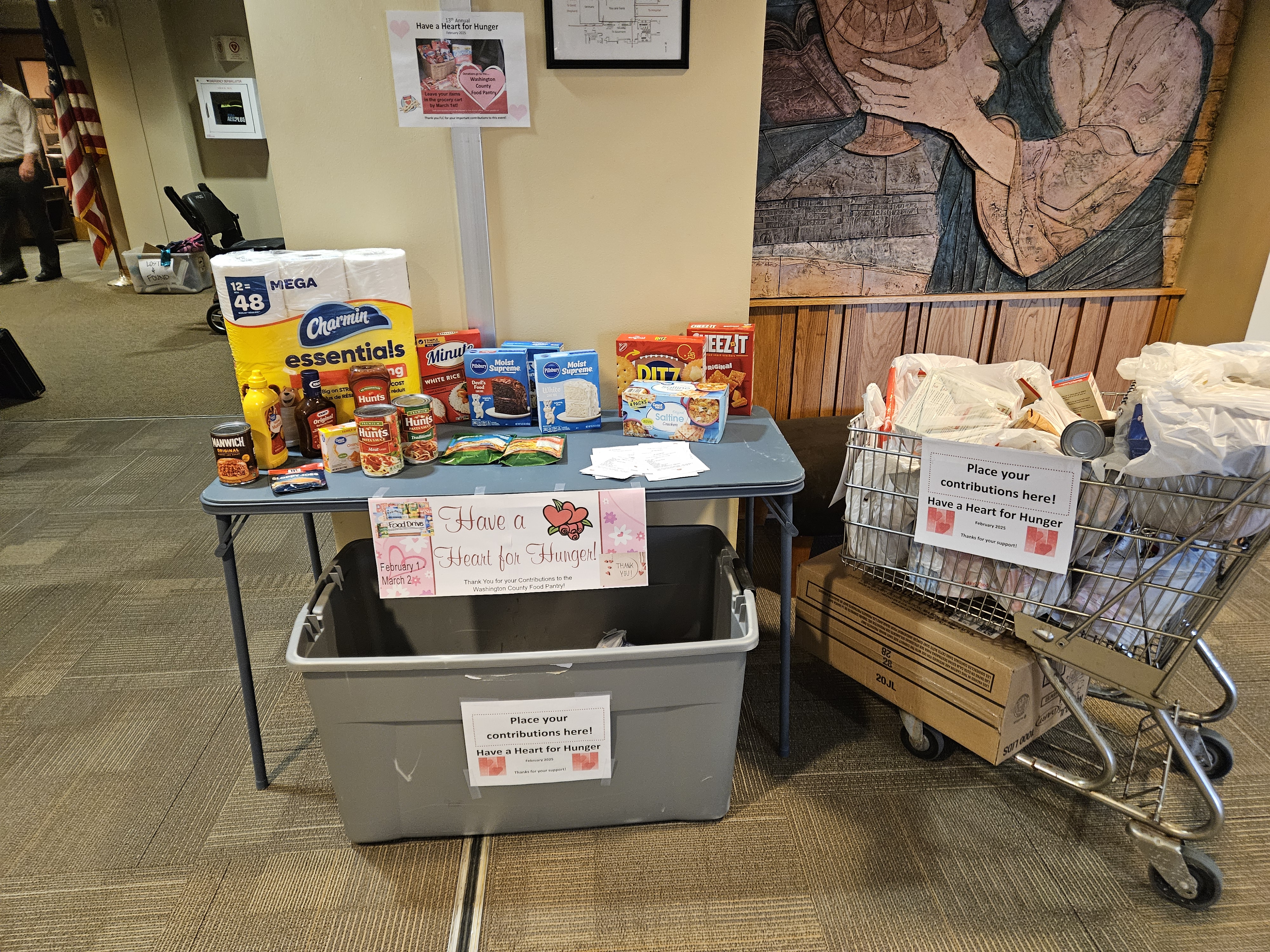
First Lutheran, you live this out daily. You live this out by being Christ’s hands and feet, offering love and mercy as Jesus commands. You live this out by the way you feed your neighbors with a midweek meal, and gather together for worship and discipleship. You live this out through the way you walk together with your larger community, like was especially on display this past year in responding to the tornadoes and meeting your neighbors where they are at, continuing to do all you can to provide for your beloved in need here in Blair and Washington County. Thank you for doing all of that good, faithful, and important work!

We Each Have a Role to Play
This work we share as God’s people together, we also share knowing that each of us has unique gifts and vocations. These roles, responsibilities, and identities are all gifts from God that flow from our baptisms. And there comes time when some are set apart for certain unique calls.
Today is one such day, as we prepare to officially install your Pastor Glen Thomas. In the role of pastor, God entrusts responsibilities to share the Good News through word and deed, to administer the means of grace and sacraments as Jesus’ real presence and promise here and now. To equip, empower, and encourage all of God’s people as we grow and serve together.
Pastor Glen thank you for continuing to answer God’s call for you. As you do this, I know that you know it’s not all about you though. This call is a call extended by God’s people, and for God’s people. First Lutheran, you have seen fit to officially extend this call to your next pastor. To invite Pastor Glen to come alongside you. To walk and wonder together. To imagine and pray together. To be God’s people together here. This is a beautiful partnership, and relationship. And as Jesus reminds today, we have a lot of work to do to bear love and mercy for one and for all. As you commit to one another, do so with deep trust, hope, and commitment that when there may be times of challenge, confusion, misunderstanding, or conflict, you will all take a breath. Pray. Communicate. Listen. Invite God’s presence. And together, as God’s people you’ll be modeling the good news of love, grace, mercy, and reconciliation that Jesus proclaims.
What Might God be up to and Inviting?
As we remember these stories today, and commit to the work and ministry together, I want to return to my wondering about the depth of human spirit. I wonder if God is actually inviting us during this time we find ourselves in today to discover more deeply that which holds us together? What might that look like for you, First Lutheran? In this wondering, what else might God be up to and inviting? What might God be calling forth here with, for, in, and through you?

We may not have all the answers to these questions. But through the very act of asking and wondering them, we know that God is up to something. Through the risk to go deeper, the gift and depth of human spirit might just flourish. So as you come together officially as pastor and congregation, bring your questions. Bring your imagination. Bring mercy and love. And bring your full selves as disciples, stewards, and Children of God. As you do this, you will be living signs of Jesus’ love and mercy for all of God’s beloved. And as you do this, know that you aren’t in this alone. We are in relationship together as God’s people. And even more so, we are in relationship with our God in Christ who is for you, with you, and who loves you. Always. And for that we can all say, thanks be to God! Amen.
Citations and References:
[1] The congregation has been journeying together with a series on spiritual gifts that are important in this current time based on ideas from Brian McLaren’s Life After Doom.
[2] Genesis 45:15, NRSV.
[3] Luke 6:27, NRSV
[4] Luke 6:35-36.
[5] Luke 6:31, NRSV.
[6] Luke 6:35-36, NRSV.
[7] As in Luke 6:17-26.
[8] Luke 6:37-38, NRSV.
 Timothy Siburg