

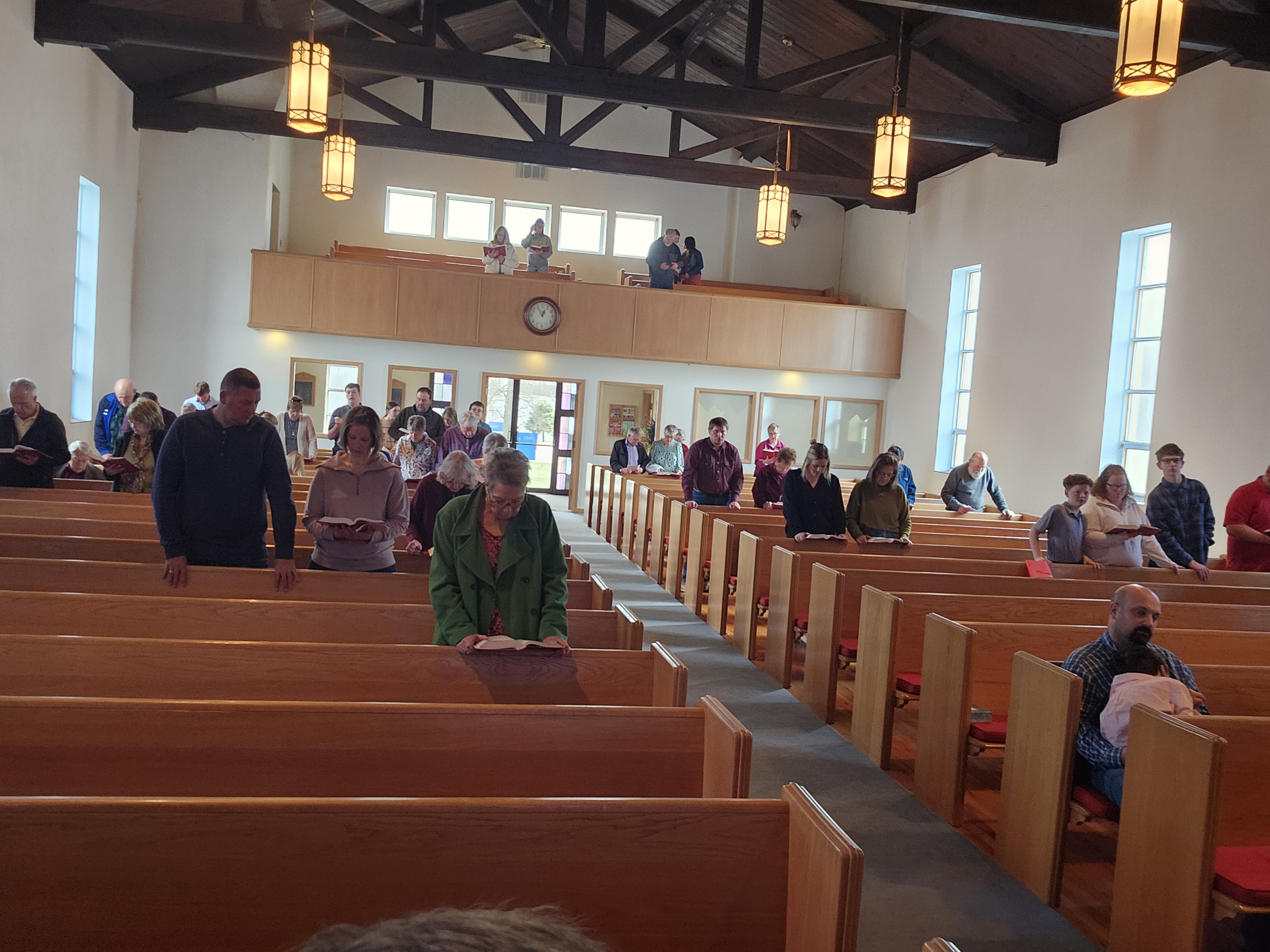
It was a joy to be with God’s people gathered as St. Paul’s Evangelical Lutheran Church in Falls City, Nebraska on Sunday March 23, 2025. Thank you Pastor Joanna Kathol for the invitation and to the whole congregation for the warm welcome. In being with the congregation I was invited to preach as part of the congregation’s Lenten series, “Cultivating Love through our Response.” The theme for this week was “Cultivating Love through our Response to the Need of Others.” As part of this series, the congregation has been hearing different scriptural texts to dig deeper. This week’s theme passages were Matthew 25:31-40, Isaiah 58:6-8, and 1 Peter 4:7-11. What follows is the majority of the manuscript of the sermon that I preached from based on these texts. In my visit I also had the gift of bringing words of greeting from Bishop Scott Johnson and the whole Nebraska Synod, as well as words of gratitude for all of the ministry that St. Paul’s Lutheran is a part of and makes happen.
Grace and peace from God in Christ, who is with you, for you, and who loves you. Amen.
Cultivating Love through Our Response
St. Paul’s, again it is so good to be with you today and to join you as part of your Lenten series on “Cultivating Love through Response.” So far you have thought about responding to God in prayer and with your time. Today we’ll be thinking about responding to the needs of others, and then the next couple of weeks you will have the chance to go a little deeper thinking about responding with our resources, treasures and all that God provides, and in offering our full selves to God.
As I think about this theme which you have embarked on like many congregations in the Nebraska Synod this Lenten season, I have to share a first wondering. In addition to being your partner in ministry on synod staff, I am also the husband of a pastor, and the dad of two very energetic and passionate young girls. They are at the stage where they don’t always know how fast or strong they are, until they end up running into a wall or losing their parents in the dust as they try to keep up with them. They think the world is a stage too, and they always love to pretend like they are giving a concert or performance. It’s so much fun, most of the time.

Like a lot of kids their age, they can sometimes seemingly get lost in their own heads and worlds. But when they are paying attention, they can ask some of the deepest, hard-hitting, and honest questions. Perhaps none more so than when I hear from one of them when they see a neighbor struggling and asking for help at the street corner. It’s a pretty common question from both of my daughters. They might ask, “Daddy, are they okay?” And then they might quickly follow-up, “Daddy, how can we help?” If those questions don’t get you right here, I don’t know what will. Of course our human nature might try to reason away that perhaps it’s a scam, or, it wouldn’t be safe to meet our neighbors there. My nature as a dad who wants to protect his girls, might be to quickly drive off. But my daughters won’t always let me do that. Sometimes I might be able to give a little money, though I am a Millennial in the classic sense of that generation who doesn’t really carry cash. But other times, because I am the dad of two girls, I usually have some snacks and sometimes even a sandwich or two in the car. And those things, if they are helpful, I gladly give away. It’s not always much, and it never feels enough. But as a Dad, my daughters have called me to pay attention and to respond. And perhaps they get this theme even better than I do?
Diving into the Word
Today we hear some of the sayings and wisdom that Jesus gives to the disciples. In Matthew’s gospel, we’re in the midst of Holy Week. He’s already entered Jerusalem triumphantly on Palm Sunday, and we’re in the in-between space now between Sunday and Thursday, if you will. So, Jesus squarely has his eyes on what is to come in mere days and hours ahead. And he will use every last second to teach, preach, and equip all those who might listen.
Jesus describes the work of the Son of Man, who he says, “will separate people one from another as a shepherd separates the sheep from the goats.”[1] I don’t know what it is about this passage, but it has never set well with me. Perhaps it’s the idea of God as judge. Perhaps it’s the image of this being a sort of apocalyptic and end time story. Perhaps it’s the juxtaposition of God’s love here. Perhaps it’s the tension in the image of shepherd, as we might think of Jesus as the Good Shepherd who will leave the flock to go out and find the one who has wandered off and meet them where they are at. Either way, today Jesus doesn’t mince words. He gets right to the heart of the matter. And perhaps that’s what’s most helpful about this juxtaposition of sheep and goats, it draws us in and makes us pay attention.
But there is good news here. For those who have responded and followed Jesus’ call and invitation, we hear the words to the sheep. “Come, you that are blessed by my Father, inherit the kingdom prepared for you from the foundation of the world.”[2] God provides, and God does so abundantly. This is a central stewardship truth of who God is and whose we are, as God’s beloved children. But as such, we do have responsibility. God not only invites us to respond, but God also entrusts us with all that we have and all that we are in order to meet our neighbors where they are at, and to provide for their needs. Remember what the psalmist says in Psalm 24, “The earth is the Lord’s and all that is in it, the world and those who live in it.”[3] Put another way, all that we have and all that we are, is God’s. And God entrusts us with what we have and what we are to live abundant life, and to help others live abundantly too as we respond to God’s love and promises for us and for all.

So keeping this in mind, it makes a little more sense at a deeper level what Jesus describes next. He says, “for I was hungry and you gave me food. I was thirsty and you gave me something to drink, I was a stranger and you welcomed me. I was naked and you gave me clothing, I was sick and you took care of me. I was in prison and you visited me.”[4] The sheep are those who live out the call and responsibility of Matthew’s Beatitudes that Jesus preaches about in his Sermon on the Mount. The sheep are God’s beloved, who do what they can with all that God entrusts as stewards and disciples for the sake of their neighbors. They are the ones who take Isaiah’s instruction to heart, “to loose the bonds of injustice, to let the oppressed go free, to share bread with the hungry, bring the homeless into your house; to cover the naked and to be with your kin, God’s beloved people.”[5] The sheep are the ones who see beyond themselves and walk with their siblings and neighbors, meeting them where they are at, no questions asked. They do so, because they know that God provides, and God provides abundantly. They do so, because they know the rest of the story, as Jesus looking towards the cross will make clear for the disciples. Jesus proclaims, “Truly I tell you, just as you did it to one of the least of these who are members of my family, you did it to me.”[6]
Our Response Matters!
This matters! Our response to the need of others, matters. Because it’s when the rubber hits the road. It’s when God’s love is made real in daily life. It just might be when someone comes to see or sense God in Christ, with them and meeting them where they are at, in or through you or me. It might just be when someone feels seen and loved by another, who has felt lost, invisible, ignored, or worse. The writer of First Peter encourages us, “Above all, maintain constant love for one another, for love covers a multitude of sins. Be hospitable to one another without complaining. Like good stewards of the manifold grace of God, serve one another with whatever gift each of you has received.”[7] God shows up through you and me. God meets our neighbors through you and me. God’s love is made real, through you and me.

We respond to our neighbors, just as we respond to God. We respond in joy and gratitude for all that God has done, will do, and promises to do for us. We respond knowing the truth and promise of God’s work of life and salvation, the story at the heart of Lent, Holy Week, and Easter. In knowing all that God alone can do, and does, we can’t help but respond. And we do so, in part through meeting our neighbors where they are at, and this response matters.
St. Paul’s, you respond to the need of others through being part of the Nebraska Synod. Together as one synod we uplift, empower, and equip disciples of all ages. Together, we proclaim the love of Christ and promises of God for all of God’s beloved. Together, we encourage all of God’s people to ask the big questions that are on their hearts and minds, and create space to wrestle with them, wonder with them, and imagine. Together, we listen for the Spirit’s movement and invitation and better sense and discern what God might be up to and inviting.
You respond through the many serving arms for ministry of the church. Consider this. We have all seen the videos and images of wildfire destruction in Southern California. You walk with your neighbors there through the ministry of Lutheran Disaster Response. Long after the media coverage fades and the news crews stop paying attention, through Lutheran Disaster Response you will be walking with your siblings in Southern California. Just as you do through all those who continue to recover from the tornadoes and hurricanes of the past year, an dare I say blizzards and power outages of the past week.
You respond through the vital ministries of Mission Field Nebraska. You meet the needs of the incarcerated longing to hear of Jesus’ love and promise for them, through Followers of Christ. You come alongside the indigenous population through Lakota Lutheran Center and Chapel in Scottsbluff. You sense the Spirit’s movement and energy through our South Sudanese siblings at Nile Lutheran Chapel in North Omaha. And you meet your Latino and Latinx siblings for worship and feed thousands of hungry beloveds through the synod’s largest weekly food pantry distribution through San Andres Lutheran in South Omaha. Through these ministries, you not only see your neighbors’ needs, but you grow in relationship with them. And as those relationships form, God does a new thing. Fear begins to fade and is replaced with a deeper sense of community and hope as God’s people together.
Through the larger Evangelical Lutheran Church in America, you respond to the needs of others across the country and around the world. I see this daily as the Nebraska Synod’s Director for Evangelical Mission, Innovation and Stewardship. This past week I was back in Chicago for meetings at the national ELCA office. While there I heard stories of impact, of how together as God’s people we’re meeting the needs of others through “Fresh Expressions,” new ways of gathering and meeting our neighbors’ needs, especially those who might not otherwise hear the word of God or willingly walk into a church building. I heard stories of ministry happening through gatherings of community at restaurants, coffee shops, and even tattoo parlors. I had never really imagined what ministry, Bible Study, and worship would look like in a Tattoo Parlor. But that’s kind of the point. These expressions are helping us see a fuller sense of God’s welcome and inclusion, to meet our beloved siblings in Christ who might not otherwise come to see that God’s love is for them, and we as the people of God love and show up with them not out of a sense of “do this and you will live,” but rather, in response of joy and gratitude for what God has done and will do, and in response to God in Christ’s call to meet our neighbors where they are at, and to really grow into relationship with one another.

You respond to the needs of others too, in so many ways here in Falls City. Look across the street when you leave this place today and see again the play equipment in the park. You did that, St. Paul’s, to provide a place so that all children might be able to play- no matter their accessibility or mobility challenges. You shared the love of Jesus through Vacation Bible School last summer with thirty children, many of whom are not regular parts of the worshiping community. Last Thanksgiving you fed more than 250 people a Thanksgiving feast by the means of drive-through and delivery. Pure and simple, you are the People of God here in Falls City, and as such you not only meet the needs of others, you truly are Christ’s hands and feet bearing God’s abundant and steadfast love and mercy for one and all, no questions asked.
Love One and All by Showing Up and Responding
I could keep going with story after story, and example after example. But this is what it looks like to show up and respond to the need of others. This is what it looks like to do for and “to one of the least of these who are members of my family” as Jesus describes.[8] This is what it means to bear love for one and all. You do a lot, St. Paul’s, and it matters. Thank you for all that you do.
In showing up for one another, our neighbors and siblings near and far, we respond and grow in relationship. And, as we do so, as beloved, beautiful and somewhat broken Children of God, we trust that through all that we have, all that we are, and through all that we do- we do it with our God in Christ who makes it all possible, and who is with us, for us, and who loves us always. May it be so with God’s help. Amen.
Citations and References:
[1] Matthew 25:32, NRSV.
[2] Matthew 25:34, NRSV.
[3] Psalm 24:1, NRSV.
[4] Matthew 25:35-36, NRSV.
[5] Based on Isaiah 58:6-7, NRSV.
[6] Matthew 25:40, NRSV.
[7] 1 Peter 4: 8-10, NRSV.
[8] Matthew 25:40, NRSV.
 Timothy Siburg